In search of Sacred Water
The Holy Wells of Laois
The Holy Wells of Laois are becoming few and far between.
They have slowly disappeared from the landscape and few are to be found today.
These various structures are often thought of as unimportant. Their significance has faded with time and their association with religious practise has rendered them unnecessary to the needs or wants of an increasingly secular society.
Unfortunately much like the advertisement for the constant Shop Sales, "When they're gone, they're gone."
While old abandoned Churches dot the landscape and are easily seen because of their sheer size, small or sunken Wells are much easier eradicated from the landscape through vegetative overgrowth or destruction at the hands of humans.
Many Holy Wells probably predate Christianity in Ireland. Perhaps some were sources of ancient Celtic or Druidic rituals. It's even likely that others were used as sources of drinking water long before the Bronze Age though which it would be impossible to tell.
Local traditions are often associated with each Well and many were visited on Pattern Days when the Saint's Feast Day was observed.
Some Well's are reputed to be restorative or cure various ailments.
In places Holy Wells are remote or isolated and can be great places to visit to take some time out. There often seems to be a tranquillity, if not a mystique which surrounds them. It is nice to sit awhile nearby and ponder on the previous generations who visited them, perhaps in a group or in a solitary pilgrimage or as an act of penance.
As a source of historic importance and ancient traditions it's difficult to comprehend how little statutory protection is afforded to these ancient monuments. They seem to be little thought of and considered to be of little value however it's impossible to put a value on such intrinsically and culturally important artefacts. The old adage of knowing "the price of everything and the value of nothing" springs to mind when I think of them.
Many Wells are set in idyllic surroundings far from the hustle and bustle of modernity. They make a perfect place to rest and soak up the surrounding atmosphere, taking a while relax. A momentary "time out" from modernity or the always on and toxic presence of anti-social media.
Below I've listed some of the remaining Holy Wells of Laois.
There are several others scattered here and there. Access at times can be a problem when they are sometimes located in the middle of farmed fields or located on what may since have become private land. Others are difficult to find and are buried almost forgotten deep in undergrowth or Scrub.
I've included below a brief description of the Well and any nearby objects of interest. I can't claim exhaustive knowledge on each of the Holy Wells but you can be sure somebody in the vicinity of each Well has comprehensive details of its history and any traditions surrounding it.
----------------------------------------------------------------
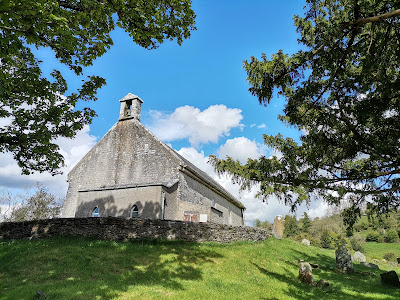
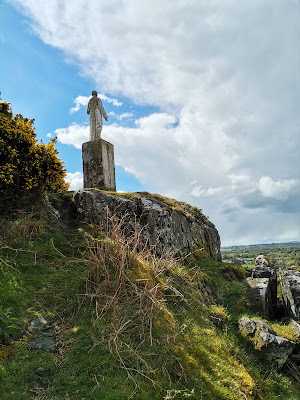
At Ballyadams in Laois close to a medieval Church ruin which holds the Harpole Tomb and the Bowen effigy there was once located two Holy Wells, Tobernasool and Toberneeve. These Wells were located in what was originally a wooded marshy area.
Today the woods are long gone and the marsh has been drained and replaced with agricultural fields. I found just one Well here but it's possible the other was somewhere nearby but I didn't see it. The only indication to the presence of the Well on a small rocky outcrop were two small devotional Statuettes.
It was quite humbling to see the little figures standing there marking the position of the Holy Well. It brought home to me the reality that even today these remote places of sacred devotion are still remembered and tradition is observed.
I've included below a few photographs from the nearby old medieval Church at Ballyadams as well.
----------------------------------------------------------------
The small hamlet of Ballintubbert in Laois has an unusual connection with the famed actor Daniel Day-Lewis. His father, Cecil Day-Lewis was a Poet Laureate and born in Ballintubbert while his Grandfather was the Parish Rector here.
In the grounds of the small and somewhat quaint Saint Brigid's Church of Ireland built c. 1785 is the similarly named Saint Brigid's Well. On my first visit it was clogged up and overgrown but on my second visit it had been cleaned and cleared up. This is a nice quiet place to visit at any time.
-------------------------------------------------------------
Outside the village of Rosenallis as you head towards Clonaslee there is a Townland called Lackan. Here on a small gently sloping Hillside is a Holy Well which seems to have been forgotten about.
I can find no information as to which Saint the Well is dedicated for however it has been in use since at least the 1800's if not earlier.
Just inside the Well's stone built enclosure is a small niche, almost like a Church aumbrey which may have once held small devotional objects or a vessel for lifting out water.
There is a strangely carved stone near the Well. I believe that there is a small Plaque somewhere on the Well commemorating an 1800's Parish Priest although I didn't see it myself.
Nearby was an old shed like building I passed shortly after leaving the Well. It was originally a small cottage and the roof of corrugated Iron was most likely a replacement for a thatch or straw roof. Much like the Holy Well on the hillside this old vernacular home stood like a ghostly relic from the past.
----------------------------------------------------------------------
Near the town of Mountrath on the Portlaoise road is Clonenagh. This is a site associated with Saint Fintan of Clonenagh born c. 524 and it was most likely at one time a hugely important monastic settlement with possibly several Churches on the site.
Any trace of the early Christian settlement however has long been subsumed into the landscape and only a large scale archaeological investigation would shed more light on the area. There are various mounds dotted about the landscape here.
Originally there was a Well dedicated to Saint Fintan here at Clonenagh however it was covered up by the landowner. Legend has it that the waters from the Well subsequently rose up into a hollow in the bole of a nearby Sycamore tree.
The tree died off for a while, poisoned perhaps from the metal of coins embedded into its trunk as offerings.
It subsequently regrew however I've never seen the reputed waters from Saint Fintan's Well appear in it despite stopping on many occasions.
It's an interesting story though and shows the importance of local folklore in keeping tradition alive.
The modern road divides the old ecclesiastical settlement in two with Saint Fintan's Tree, early and medieval Cross slabs and a Cemetery on one side and a Graveyard and 16th Century Church ruin on the other.
The various Christian Cross slabs are important archaeological artefacts which deserve a purpose built enclosure or at the very least some type of overhead protection from the elements.
On one visit I had to pull piles of decaying grass of them, a sorry state of affairs.
With the paucity of archaeological artefacts on the ground in Laois it never ceases to amaze me how little care is afforded to the few that we have in the County.
---------------------------------------------------------------------------
Kilgory in Laois is a spot from where you could throw a stone and get it to land in nearby Kilkenny. In a south easterly corner of Laois it is close to both the Kilkenny and Carlow borders.
Here is to be found the Holy Well of Saint Longory. It sits to the side of an old Graveyard at a place where it is believed a Church once stood.
There is a small modern building at the site which houses an altar and devotional items. Near the well is a Hawthorn Tree, a "Rag Tree" on which small pieces of cloth or little objects are often deposited as offerings and oftentimes accompanied with pleas and prayers for help with sickness or bad health or guidance or guardianship from above for family abroad.
As a secular individual I still cherish the sight of Ireland's many "Raggedy Trees." They are a potent symbol that rites and ritual can still find a place among a world awash with Hyperthreading Octacore Processors.
The origins of Saint Longory's Well are a bit of a mystery. To start with was there even a Saint Longory? I can find mention of Lon, Longory, Gory and Gabhair.
Who they are and what relationship they bear to the Well I have no idea and can find no definitive information on the origins of the name. Suffice to say that Saint Longory's Well is probably also called Kilgory Holy Well and a host of other names depending on who is referring to it.
Irrespective of the origins of the Holy Well at Kilgory the area is nonetheless quiet, tranquil and not a little bucolic. It makes for a nice place of pilgrimage whether secular or practising.
--------------------------------------------------------------------
Not far from both Bob's Bar and a bridge on the River Erkina in Durrow County Laois is another Holy Well dedicated to Saint Fintan. It was also referred to as "Fantan's Well."
In this instance however and despite a good search I could not locate the Well. I was subsequently informed that the Holy Well now lies behind a Wall on private property.
Funnily enough my secular thought process immediately still thought "what sacrilege" when I found this out.
It is also possible that this information is incorrect and I just couldn't find the Well on that occasion. That's as good an excuse as any to visit Bob's Bar and Durrow again sometime.
----------------------------------------------------------------------------
Kilfeacle near Wolfhill in Laois is a spot that has broken my heart.
Countless visits were undertaken in an effort to locate what is described by the National Monuments Service as a "Holy Well in a sub circular area surrounded by a modern stone wall."
On several occasions I was "torn asunder" by thickets of thorn and Blackberry bushes as I seemingly searched in vain close to where it was positioned on a map.
It never surfaced despite my torn and bloodied legs bearing witness to my efforts.
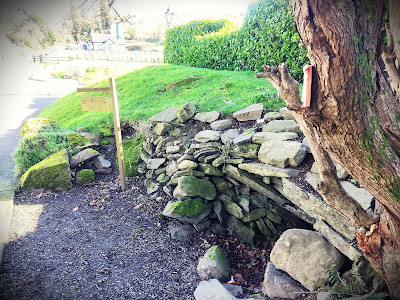
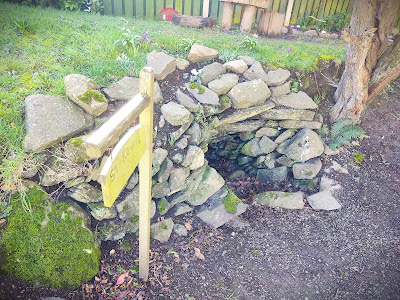
After several visits and finally being directed by a local I found a Well on the opposite side of the road altogether and on a bit further up the road at a place called "Furze Hill."
This Well is described as Furzehill Well on the Casseni 6 inch-1830's historic mapping.
The entrance from the roadway was literally invisible, nothing more than a tiny break in undergrowth that was almost unnoticeable.
I wouldn't have discovered it without the help of a local for which I am immensely grateful.
I was told that up until recent decades older locals used to draw water from the Well for drinking. It was thought to be good for health. Buried deep in undergrowth the little spring was very overgrown with Ferns and vegetation.
There was a small pot which must once have been used to collect water stuck in a tree trunk. The truck had actually grown into the handle of the pot.
There was also a set of Rosary beads beside the Well which led me to believe that whatever about it once being a source of drinking water it might also have been a devotional site, a Holy Well of some type however obscure, although I stand to be corrected.
I am basing my assumption solely on the presence of the Rosary Beads.
Despite all the trouble finding the Well and despite the Well being heavily clogged with mud and plant material it was a pleasure to take some time out here.
There seemed to be a thick atmosphere in the air, a stilly quietness that cloaked the hillside in mystique and mystery. It had obviously been many years since last a human hand touched its waters.
Who had come here previously in centuries past? Did they linger in quiet contemplation and prayer or were they just collecting fresh drinking water? I will probably never know and Furze Hill will keep its secrets all to itself.
As for the undiscovered Saint Patrick's Well at nearby Kilfeacle, perhaps it's one for another day.
-------------------------------------------------------------------------
Saint Kavan's Well is at Annatrim in Laois. It's a fresh water Spring which has an unusual "Saint's Stone" beside it.
It is located near both Saint Jude's Church of Ireland c. 1835 and an earlier unusual style Church described as a "late medieval Parish Church."
Saint Kavan's Well is also referenced as Saint Kaban's Well and the area is associated with the foundation of a settlement by one Saint Mochaemhog.
Mochaemhog is also associated with Liathmore in North Tipperary however there is also a Saint Mochaemhog of Fermanagh.
Saint Kavan was probably Coemhan and little is known of the original history of the site.
The Saint Stone was partially covered in grass and built up vegetation so I had to pull some off to get a photograph of it.
The unusual Saint Stone at the Well has small holes in it and may have previously been some type of repurposed Milling stone.
There was a Pattern Day held here in the month of November which was a ritual that lasted into the 1830's.
------------------------------------------------------------------------------
The popularity of Saint Fintan in Laois is evidenced by yet another Holy Well dedicated in his honour at Cromogue.
The grounds within which the Well is located are carefully maintained and well looked after.
As can be seen by the various devotional objects and offerings of coins in the Well's waters this is a Holy Well that is often visited.
Despite that there was no one else there when I passed which made for a tranquil and relaxing few minutes.
There is a small and evenly worked Bullaun Stone near the little stream which flows from the Well.
Saint Fintan is reputed to have lived for a while at the nearby site of Cromogue's ruined early medieval Church which is about 300 metres away form the well.
An ancient stone causeway or Togher once ran from here to Clonenagh.
-----------------------------------------------------------------------------
In the small village of Rosenallis lies Saint Brigid's Well. It is rather plain but nevertheless of significant cultural importance.
The well is fed from a Spring and is easily visible from the roadside as you pass through the village.
A Sheela na Gig exhibitionist figure taken from Rosenallis is housed at the National Museum of Ireland.
In the local Roman Catholic Church are some impressive and intricately decorated early Christian Cross Slabs which came from nearby Rearymore.
There is little to see at Rearymore now as most of it's old Church ruins have collapsed however the Cross Slabs at Rosenallis are delightful.
There was once some type of Tower at Rosenallis, possibly an ancient Round Tower.
It was destroyed by a Priest who described it as attracting nothing other than Crackpot antiquarians and Jackdaws.
The Quakers established several communities and towns in the Laois area and the Quaker Burial Ground the "Friends resting place" is on the edge of the village.
-------------------------------------------------------------------------------
At Morett in Laois is an unusual shaped Bullaun Stone which lies beside Saint Brigid's Well.
There was once a Church and Graveyard at this location.
The Well and Bullaun Stone are located on farmland and access should first be sought if attempting to visit.
The Bullaun stone has a crack or channel running along the top of it.
-----------------------------------------------------------
A few kilometres from Ballinakill in Laois is Dysart Gallen, a beautiful and secluded little Glen.
There is an old medieval Church ruin here and on a Roadside nearby is a "Raggedy Tree" and the base socket of a Cross which is a rarity in Laois.
The old Church predates the 1600's and is associated with a Saint Monahan who purportedly died c. 648 however Monahan may well be
Saint Manchán of Lemanaghan or any of multiple Saints named Manchán.
Early Christian Saints are often obscure with confusing records to match.
These ecclesiastical artefacts and associations led me to thinking that a nearby roadside source of crystal clear fresh water might be a Holy Well.
As it turned out historical maps of the area list it as merely a fresh water Spring however I'm including it here as a place of interest worth visiting.
A local man who lives nearby has a visitor book to sign if you visit the Church.
He has a wealth of information on the area. I offer my apologies for forgetting his name.
-------------------------------------------------------------------------------
The Lady's Well is a significant Laois Holy Well with one important caveat.
It isn't actually in Laois. The entrance is on the Durrow road which runs from Durrow to Ballinakill, both in County Laois.
Once through the entrance gate and roughly 100 metres further on and you've actually crossed the County border into Kilkenny.
The Lady's Well is reputed to cure ailments of the eyes.
There is a large statue of the Virgin Mary in a type of modern enclosed Grotto. A pathway winds around the site in a square shape. This presumably is a processional walkway.
There is also a large area with covered overhead protection which would provide protection from the elements to a small gathering.
I believe that at one time crowds of several hundred gathered here on Pattern days. Perhaps they still do.
Legend has it that Cromwellian troops stabbed a Priest to death near the Well.
Locals retrieved the body and washed it with water from the Well. Another story tells of how water was taken from the Well to make Butter. The water subsequently turned to blood in the Butter.
There may be some truth to the legends as the nearby 13th Century Abbey Church at Rossconnell was destroyed by Cromwellians in the 1650's before being rebuilt. Curiously just like The Lady's Well it too is just across the County border and about 50 metres into Kilkenny.
-----------------------------------------------------------------------------------
About a kilometre outside Clonaslee is a ruined medieval Church originally dating to roughly c. 1550 although most of the building looks to be a Century later.
This is Kilmanman and Saint Manman's Holy Well was once located close to the Church.
It is described as "infilled" now however in a field directly adjacent to the Church stood what looked to me like a Whitethorn or Hawthorn tree in a small fenced off circular area.
It is possible that this is the site of the old Well however it's just a guess on my part. The area is worth a visit if just to enjoy the tranquillity and the old Church.
Little is known of Saint Manman.
He is reputed to have built a Church in this area during the 7th Century.
Conservation works have been undertaken on the medieval Church there now.
It is a quiet and beautiful area. If you go and visit see if you can spot the repurposed grinding stone.
-----------------------------------------------------------------------------------
At Errill in County Laois lie the ruins of Saint Kieran's Church. Nearby is the remains of Ballagharahin Wayside Cross, an early 1600's Cross dedicated to the Baron of Upper Ossory and his family.
Mounds, low earthworks and banks dot the immediate locality and serve as evidence for a now vanished monastic settlement.
Within 200 metres of the Church ruin is listed Saint Kieran's Tree and Holy Well. On a wet rainy day with the ground nearby slightly marshy I quickly and a little all to easily gave up on my search for Saint Kieran's Well.
It will have to wait for another day. Perhaps one to search for on a nice sunny day.
The pictures below are of Saint Kieran's Church ruin and graveyard and the Wayside Cross at Errill.
----------------------------------------------------------------------------------
In Portlaoise there is a nice memorial Plaque to Biddy Aghaboe and a Well that was named after her. It is beside a Railway Bridge on the old Mountrath Road and commerates the time when Biddy and her Cow saved the town from a severe drought.
The Well is long since gone but the Plaque is a nice touch and helps promote local history in the area. While not strictly a Holy Well it's an interesting bit of local history nonetheless.
------------------------------------------------------------------------------------
And last but not least a mention goes to Heywood Gardens near Ballinakill where I came across this nicely maintained Grotto.
A small stream trickles slowly through the Grotto but I haven't actually found any reference to it as an actual Holy Well however I've listed it nonetheless as a place of interest and somewhere nice to visit.

--------------------------------------------------------------------------------
Finally the records of Sites and Monuments (SMR) lists just fifty Ritual Sites/Holy Wells for the entirety of Laois.
Of these the majority are shown as infilled, no visible trace, no surface remains, or just not located. Some of the few that remain are located on private property and difficult to access.
Without Local authority and community action it is likely that more will be lost, filled in or forgotten. This state of affairs leaves a diminishing archaeological and cultural point of reference for the future generations of Laois.
Just one more artefact superfluous to modernity and secularism wiped from the landscape, forgotten and never to be retrieved.
Keep the wheels turning.
The Screenshot below lists the fifty Townlands in Laois on the SMR which have or once had a Holy Well.