The Wart Stone
53.250129 - 7.434895
Old Stones, Bones and Ice Cream Cones while Motorcycling and Cycling throughout Ireland.
At Ashley Park near Ardcroney in Tipperary there is an unusual type of neolithic funerary monument called a Linkardstown Burial.
These type of ancient monuments are named after an area in Carlow where they were first discovered in 1972.
Classified as a unique archaeological field monument they are a different type of neolithic burial which have occasionally been mistaken for undifferentiated Passage Tombs.
Sometimes rectangular types of Linkardstown burial were mistakenly believed to be neolithic Passage Tombs without side chambers, i.e. undifferentiated.
The polygonal stone remains of some smaller exposed Linkardstown burials are ocassionally mistaken for Dolmens/Portal Tombs. Others remain difficult to correctly classify.
Linkardstown burials are often discovered accidentally and the burial at Ashley Park was found while the site was being Bulldozed and about to be prepared for a field clearance of scrub, trees and vegetation. It had lain undisturbed and little known in recent centuries buried in what was originally forestry.
The chief differentiator of Linkardstown burials from neolithic Passage tombs is that they generally represent a single individual burial tradition.
Very occasionally there are two sets of remains found. Sometimes secondary burials are also found on site and this is often where a burial site was reused again, perhaps as much as a thousand years later.
The Linkardstown burial is typified by a polygonal or rectangular Cist, a "boxy" type structure. Usually there are sherds of Pottery present which help to accurately date the tomb.
They were built c. 3500 B.C. which is about 5,500 years ago and they were first identified in 1972.
The Cist tomb can contain a single and sometimes two burials. Remains can be both cremations and inhumations. Skeletal remains can be both articulated or disarticulated.
The whole Cist structure is covered in a large mound or cairn of smaller stones which itself is subsequently covered in soil or clay which more often than not has grass growing on it.
A peculiar feature is the distinctive difference between a polygonal and a rectangular Cist style Linkardstown burial.
They look completely different and at first sight you wouldn't think they represented the same type of archaeological field monument however several other defining features link both types together.
The most obvious link is that of the individual neolithic burial ritual.
Where Linkardstown burials were uncovered or where large burial mounds were to be seen in the landscape it was often believed in local traditions that a "King" was buried there or had been uncovered.
Oddly enough this superstition may well ring true. A huge effort went into constructing these monuments to the dead which were all built by hand.
It's difficult to appreciate the amount of work required because we are used to mechanisation and machines.
For such efforts to be expended on behalf of an individual burial it's safe to assume they contained the remains of powerful or influential individuals.
Perhaps they were tribal leaders, important elders or Shamans. It's anyone's guess.
The Linkardstown burial at Ashley Park is rectangular in shape with huge floorstones and side walls. The Capstones were damaged and removed during bulldozing.
To the rear of the burial mound are large stones which at first glance look like some type of fallen orthostats.
These stones are in fact nothing to do with the burial mound and are classified as glacial erratics which are large stones or boulders left behind by retreating glaciers during the last Ice age.
Known Linkardstown burials are few however they are geographically widely distributed throughout Ireland. Perhaps more will be discovered and classified as time progress's further.
It's difficult to picture who built them. Were they built by the same societies who built the impressive Passage Tombs ?
Perhaps different societal groupings existed side by side simultaneously with different burial traditions and rituals. Maybe they were a newly arrived peoples or perhaps Linkardstown burials merely represent a slow evolution of burial practices culminating in Bronze age Cists.
Coordinates for Ashley Park Linkardstown burial here:
52°56'01.8"N 8°11'20.4"W
52.933836-8.189007
Keep the wheels turning.
53°16'44.3"N 7°36'48.8"W
53.278960-7.613544
Laois Standing Stones
Standing Stones are generally regarded as Bronze Age field monuments. Occasionally a few are believed to date to the later Iron Age period.
Standing Stone at Skirk, Laois
In Laois we have very few remaining Standing Stones although there are many references to places and areas where they were once located.
Many have long since been knocked over or removed from the visible landscape around us today.
Standing Stone at Clonfertmulloe, Laois
The ancient Stones are a bit of a mystery as they predate historic record. There are no written records which describe their function and there are no tales which have survived handed down in oral tradition from the Bronze Age.
This was a time when it's likely that language may well have been different from anything which survives today from Old Irish.
Standing Stone at Clopook, Laois
The enigmatic stones may have served as boundary markers or territorial signs.
They may also have possibly been wayside markers on ancient routes or places for small gatherings. Perhaps they marked a place of ritual or maybe were associated with a nearby burial.
It's impossible to know exactly what they signified and although while the overriding opinion seems to accept them as ancient boundary markers we will never know for sure and indeed they may have served several different functions.
Recumbent and fallen former Standing Stone at Skirk, Laois. Perhaps it was knocked over by Cattle using it as a scratching post.
Many Standing Stones were destroyed clearing fields for tillage and farming. People paid little attention to them and were busy enough trying to survive on a day to day basis.
There was little need for Archaeology or Heritage information in days of old. Most were probably seen as nothing other than an awkward obstacle to a horse and plough, ripe for tearing from the soil to make ploughing the field a little easier.
I've included a few photographs of some of the Standing Stones found in Laois. Although none are particularly striking visually I like to think that they are nonetheless hugely important monuments.
Below are three photographs of Gortnaglogh Standing Stone.
It was also called the Mass Stone and it is believed that Mass was held at this spot during the repressive times of the Penal Laws in Ireland.
Priests were often hunted down and murdered for ministering to their flocks during the era of the Penal Laws.
Below is The Fiddlers Rock - A large quartzite Standing Stone at Glenafelly in the Slieve Bloom Mountains. Not quite Laois it's just across the border in Offaly.
As quartzite doesn't occur naturally in the Slieve Bloom mountains this rock is believed to be a glacial "Erratic" carried along by a glacier during the last Ice age and presumably thousands of years later placed into an upright position by human hands.
Keep the wheels turning.........
I left a wheel into a shop a while ago to be re-spoked and fixed up. It was a bit rough and long overdue some attention. It was running as a Tubeless setup on Surly Rabbit Hole 29"s with a 2.5 inch tyre.
When I collected the wheel from the shop it had been set up tubed not Tubeless and the chap explained that he had to put on different rim tape and that the wheel was not designed for running Tubeless.
I thought O.K. no worries if that's the story but when I got home I realised that this particular bike which I generally use for cycling in areas of Gorse (Furze) and brambles and such like would now be of little use with a tubed wheel. Besides, it was previously running Tubeless before it went into the shop.
It would constantly puncture now at the inner tube from the rough terrain and thorns and Gorse spikes where I use this "Mud Plugger" bike.
I did a bit of research and seemingly a specific wheel manufacturer is no longer using Rim Tape in its Tubeless wheels but is instead using OEM unbranded Gorilla Tape.
So being verifiably stupid I bought a thick roll of Gorilla Tape to try this myself on the Wheel which the shop had set up "tubed".
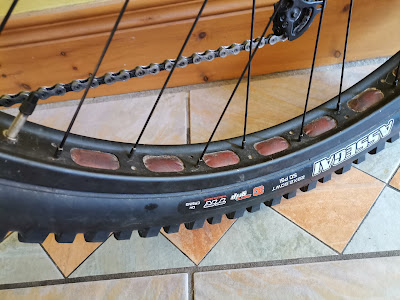
I removed the tyre and tube and got a Tubeless valve ready. Then I left the existing thick rim tape which covers the holes in the Surley wheel rim in place. I then cleaned the rim and this tape with thinners and dried it off.
Next I applied a layer of Gorilla tape around the wheel, overlapping where I started by about three inches.
If you don't have a wheel like the Surley which has large holes in the body of the rim I would suggest removing all trace of any existing rim tape. In my particular case I left the existing rim tape because I think it is needed for support. I'm not convinced that the Gorilla Tape alone on this type of wheel would be strong enough or hold up well.
I put the Gorilla tape in place while pulling it nice and tight as I went along. Next I used my fingers and thumbs going around the rim twice and firmly pushing down on the tape to ensure it was nice and flat on the rim.
I also made sure while taping the rim that the strip of tape was wide enough to cover the entire rim but not the channel that the tyre sits in. This channel/slot in the rim was left clear of tape so the tyre would fit and interface on the wheel properly.
The Gorilla Tape I used was a wide strip, a bit too wide, so I just cut a little "nick" where the tape started to make it the right width for the rim and pulled this little strip off as I went along. It worked perfectly. Then I put one side of the tyre back onto the wheel.
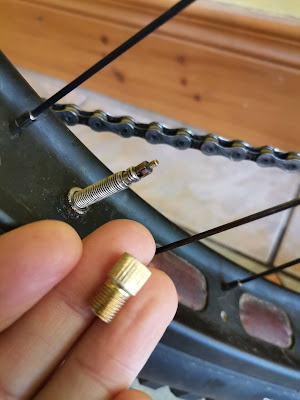
Using a scribe I put a tiny hole into the slot on the rim for the valve and then twisted the valve carefully into position through this hole as if I was twisting in a screw and I tightened up the valve nut tightly by hand.
I put the other side of the tyre back onto the wheel and when there was just a litle gap at the bottom left before the tyre was fully on and seated onto the rim I poured in four ounces of sealant before pushing the tyre fully home onto the rim.
This wasn't at all messy and not a single drop of sealant fell out. Once the last small gap in the tyre is placed at the bottom near the floor it's easy to pour in the sealant and seat the tyre without spilling it.
My track pump couldn't get the tyre properly inflated. Sometimes this is a problem when tyring to initially inflate a Tubeless setup so I quickly headed to the local Garage and used their compressed air pump to pump up the tyre. I initially pumped it well past specification just to get the tyre to "pop" onto the rim and get it seated properly.
Because the Valve was a Presta type I put on a little adapter which changes it to a schrader type before heading to the Garage. These are handy to have and can be got online cheaply for about a euro each.
I then "twirled" the wheel around to get a nice layer of sealent spread around the inside of the wheel and the rim and finally I bounced and spun the wheel up and down a bit off the ground. Because I was at a Garage forecourt this got me a few funny looks.
The wheel has been on a few days now set up as Tubeless and it hasn't lost any air pressure at all. When I initially thought about it the process seemed daunting but when I broke it down into simple stages it turned out to be a very easy job to do.
Simple in fact so don't be afraid to have a go at converting any wheels you may have that you might like to use as Tubeless. As far as I am aware almost all modern wheels will accept a Tubeless ready tyre and I believe that many tyres not certified as Tubeless ready will also happily run set up as Tubeless.
I intend to test this out next week by converting non Tubeless certified tyres to a Tubeless setup and check them for "burping".
All I required was Gorilla Tape, a Tubeless valve, Stans Tire Sealant and a valve adapter. If you are using a Schrader type valve you won't even need the valve adapter. The tyre I used for this was a Maxxis Assegai "Tubeless ready."
I don't advise trying this at home without having either an air compressor or having a Garage nearby just in case your track pump can't do the initial tyre inflation, which is a regular occurance I am led to believe.
Keep the wheels turning......